The Living Legacy of Trauma: How It Lives in the Mind and Body
- Apr 2
- 3 min read
Trauma is not just something that happened in the past; it is something the body and brain may continue to experience in the present.
For many people, trauma doesn’t sit neatly as a story we can tell. Instead, it shows up in sensations, emotions, behaviours, and automatic responses. Understanding this can be a powerful step toward recovery.

Why Trauma Doesn’t Feel Like a Memory
Under extreme stress, the brain prioritises survival over storytelling.
The part of the brain responsible for creating a clear, chronological narrative (the hippocampus) becomes less active. Instead, the experience is stored in more primitive systems focused on survival.
This means trauma is often stored as:
Sensory fragments (images, sounds, body sensations)
Emotional states (fear, shame, anger)
Automatic responses (fight, flight, freeze, appease)
Rather than:
A clear, verbal, “this happened back then” memory
Two Key Memory Systems
1. Narrative Memory (Explicit Memory)
This is what we typically think of as memory:
Verbal and chronological
Organised into a story
Linked to time and context
Example:
“I remember what happened, and I know it’s in the past.”
However, during trauma, this system often goes offline.

2. Implicit & Procedural Memory
This is where trauma often lives.
Implicit memory stores emotional and sensory experiences
Procedural memory stores habits, patterns, and automatic responses
These systems are:
Non-verbal
Fast and automatic
Focused on survival
Example:
Your body reacts before you have time to think.
When the Past Feels Like the Present
Because trauma is stored in these systems, it can re-emerge as if it’s happening now.
This is why people may experience:
Emotional flashbacks (overwhelming feelings without a clear cause)
Body sensations (tight chest, nausea, shutdown)
Behavioural patterns (avoidance, hypervigilance, people-pleasing)
These are not “overreactions.”
They are learned survival responses.
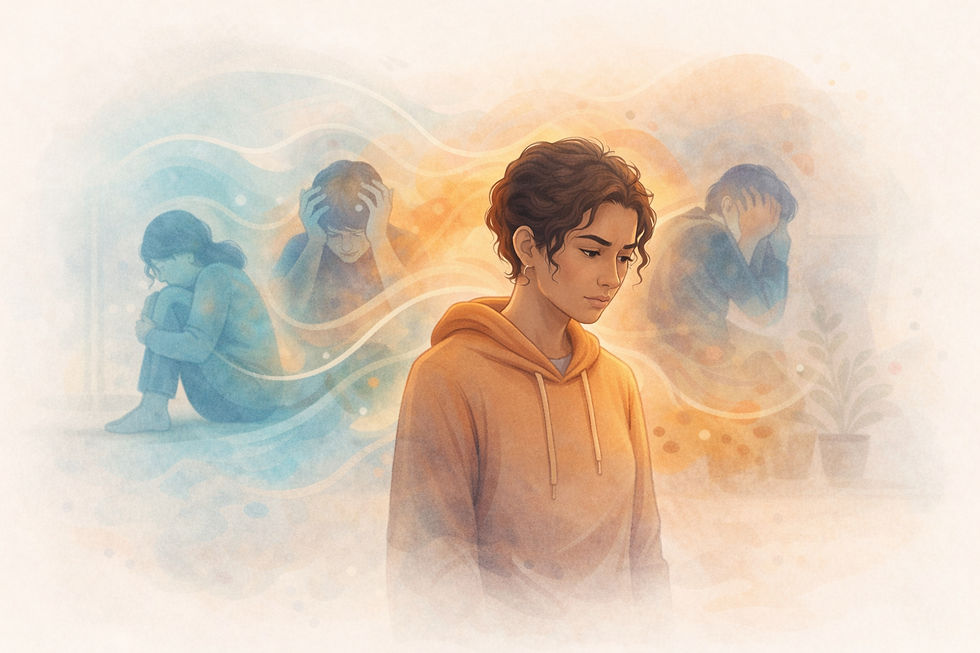
The Body Remembers
Trauma is not just psychological; it is physiological.
It can show up as:
Chronic tension or pain
Fatigue or shutdown
Startle responses
Dissociation
The body is holding patterns that once helped keep the person safe.
Relational Patterns and Survival
Trauma also shapes how we relate to others.
Some common patterns include:
Avoiding eye contact or closeness
Difficulty trusting others
Over-accommodating or people-pleasing
Expecting danger in relationships
These are often procedural adaptations; learned ways of staying safe in unsafe environments.
Enduring Patterns: The Nervous System Learns
Over time, the nervous system can begin to expect danger; even when it’s no longer present.
This creates:
Hypervigilance (“something bad might happen”)
Shutdown (“I can’t cope”)
Difficulty feeling safe, even in safe situations
This is not a conscious choice.
It is the nervous system doing what it has learned to do.
Why This Matters for Recovery
Understanding trauma in this way shifts the question from:
“What’s wrong with me?”
to:
“What happened to me, and how has my system adapted?”
This shift reduces shame and opens the door to compassion and effective support.
What Supports Healing?
Healing involves helping the nervous system learn that it is safe again.
This includes:
1. Bottom-Up Approaches
Working with the body and nervous system:
Breathing and grounding
Movement and sensory regulation
Somatic therapies
2. Safe Relationships
Consistent, attuned support helps regulate the nervous system:
Feeling seen and understood
Predictability and trust
Co-regulation

3. Gradual Integration
Over time, experiences can become:
More tolerable
More understandable
Integrated into narrative memory
Trauma is not just remembered, it is lived through the body and nervous system.
The reactions people experience today often made sense at a time when they needed to survive.
With the right support, these patterns can shift.
Recovery is not about “fixing” someone. It’s about helping the nervous system feel safe enough to change.
