Understanding Cognitive Distortions: How Our Thinking Shapes Our Mental Health
- May 6
- 2 min read
Our minds are powerful; but they’re not always accurate. Many of us move through life interpreting situations in ways that feel completely true, yet are subtly biased or distorted. These patterns are known as cognitive distortions, and they play a central role in anxiety, depression, and low self-esteem.
Learning to recognise them is one of the most effective steps toward improving emotional wellbeing.
What Are Cognitive Distortions?
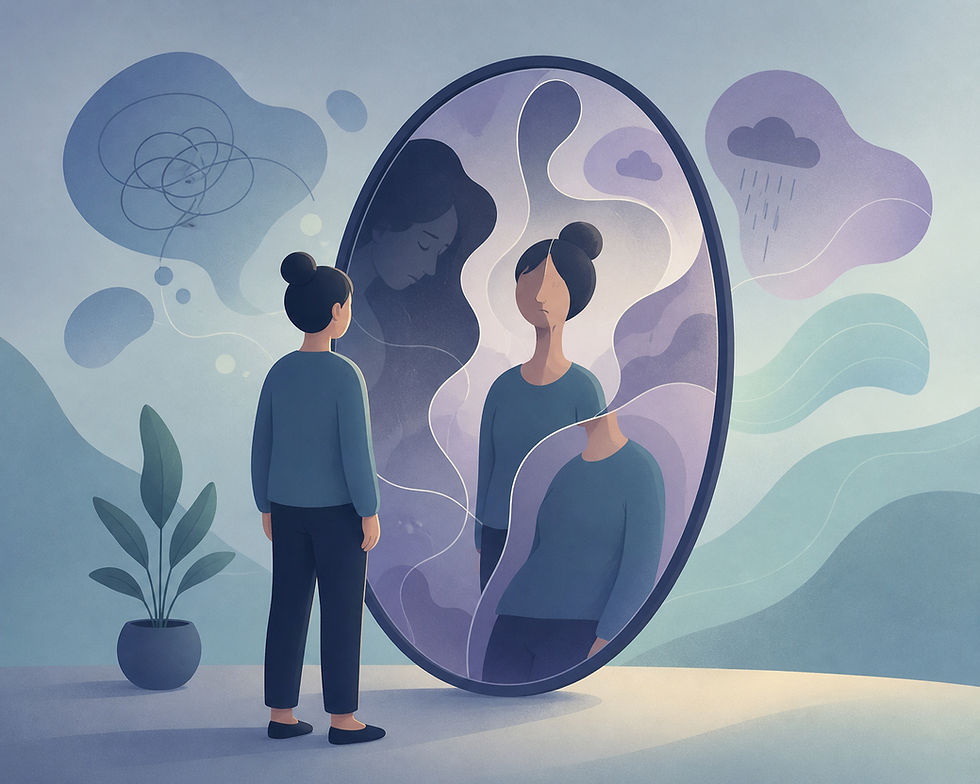
Cognitive distortions are habitual, unhelpful ways of thinking that influence how we interpret events, ourselves, and others. They’re automatic (often happening so quickly we don’t even notice them) and they tend to reinforce negative emotions.
Importantly, these thoughts are not “lies” we consciously tell ourselves. They are learned mental shortcuts that may have once served a purpose but are no longer helpful.
Common Types of Cognitive Distortions
Here are some of the most common patterns:
1. All-or-Nothing Thinking
Seeing things in black-and-white categories.
“If I’m not perfect, I’m a failure.”
2. Overgeneralisation
Drawing broad conclusions from a single event.
“I didn’t get the job; I’ll never succeed in my career.”
3. Mental Filtering
Focusing only on the negative while ignoring positives.
“They gave me one piece of criticism, so the whole thing was bad.”
4. Discounting the Positive
Dismissing positive experiences as unimportant.
“They only said that to be nice; it doesn’t count.”
5. Mind Reading
Assuming you know what others are thinking.
“They think I’m incompetent.”
6. Catastrophising
Expecting the worst-case scenario.
“If this goes wrong, everything will fall apart.”
7. Emotional Reasoning
Believing feelings are facts.
“I feel anxious, so something must be wrong.”
8. “Should” Statements
Holding rigid rules about how things must be.
“I should always be in control.”
9. Labelling
Assigning global negative labels to yourself or others.
“I’m a failure.”

Why Do Cognitive Distortions Matter?
These thinking patterns can:
Intensify emotional distress
Maintain anxiety and depression
Impact relationships
Reduce confidence and motivation
Over time, they create a feedback loop; negative thoughts lead to negative feelings, which reinforce the original thoughts.
How to Start Challenging Cognitive Distortions
Awareness is the first step. Once you can spot these patterns, you can begin to gently question them.
Here are some practical strategies:
1. Notice the Thought
Pause and ask: “What am I telling myself right now?”
2. Name the Distortion
Identifying the pattern helps create distance.
“This sounds like catastrophising.”
3. Examine the Evidence
Ask yourself:
What evidence supports this thought?
What evidence contradicts it?
4. Consider Alternatives
Replace the distorted thought with a more balanced one.
“This didn’t go as planned, but it doesn’t define me.”
5. Practice Self-Compassion
Speak to yourself the way you would to someone you support.

Cognitive distortions are part of being human. Everyone experiences them at times. The goal isn’t to eliminate negative thinking entirely; it’s to develop a more flexible, balanced perspective.
With practice, you can learn to step back from unhelpful thoughts and respond in ways that support your wellbeing rather than undermine it.


